• About
    • Privacy Policy
  • Teaching
    • Member/Student Login
    • Online Programs
  • Shop
  • Member/Student Login
  • Blog
    • Free Quilt Patterns – Scrappy Whirligig Quilt

Bryan House Quilts

Curved Quilt Blocks Beginners Guide

Quilting and Stitching· Tutorial

24 Aug
Beginners Guide to Sewing Curved Quilt Blocks

Curved quilt blocks are easy to sew with my beginners guide. I use the pinning method for curved piecing step-by-step below to show you how.

Key Highlights

  • Curved piecing is a skill you can learn as a beginner.
  • Prepping fabric and accurate cutting are important steps.
  • Glue basting and pinning makes sewing curves much easier.
  • Sew slow and steady for great results.
  • Practice makes perfect!

Sewing Curves in Quilting

I know: Sewing curves looks impossible at first. With the right supplies, tools and know-how, you can sew curves like a pro. You will even like it!

A curved seam is made with two opposite pieces: a concave piece (curved inward) and a convex piece (curved outward). The curves need to meet at the right points on each piece to lay smooth, without puckers.

Slow, steady and patient sewing quickens the learning curve. Practice the piecing technique and never mind the mess ups – it’s a learning process. This beginner’s guide will provide a step-by-step piecing tutorial using the pinning method.

Tools and Sewing Supplies

Gather these tools and supplies beforehand and I’ll show you how to use them. Making accurate fabric cuts is essential.

  • A sewing machine with a quarter-inch foot or walking foot.
  • A rotary cutter & Cutting Mat
  • Glass head pins (very thin) & cute pin bowl
  • Marking pen
  • 50-weight thread in the top spool and bobbin. Thinner thread makes smoother curves.
  • Stiletto – the handiest little tool for sewing and quilting, especially small pieces
  • Iron & Pressing Mat
  • Best Press starch
Glass head pins

Stiletto sewing tool

Rulers

Acrylic curved ruler sets take the guesswork out of cutting accurate shapes and blocks. The Classic Curves Ruler and Classic Curves Pro rulers from Color Girl Quilts, Wonder Curve Ruler or Quick Curves Ruler feature multiple sizes versus a set made for one size. Once you master curved quilt blocks, you’ll want to make them in all the sizes!

Most of the Drunkard’s Path rulers feature slots or registration marks to help you align the seams before sewing. I mark these with a pencil.

You can make your own templates from matboard, cardboard or template plastic. Quilt patterns include the templates for tracing, but I’ve found it’s too easy to shave off bits of template as you cut – oh no! Tracing a cardboard template shape onto the fabric and then cutting is better for accuracy.
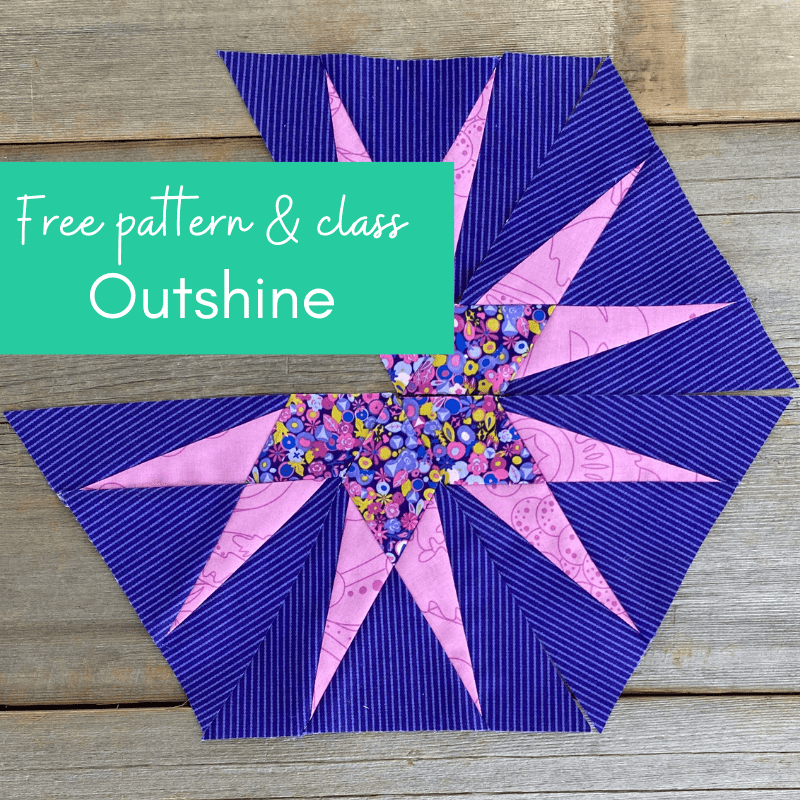
Free pattern class outshine block

Make a modern triangle in my free class and learn the magic of Freezer Paper Piecing! Download the free pattern and I’ll walk you step-by-step through the technique. Get started here!

Tutorial for Sewing Curved Quilt Pieces

Now that you have the necessary tools and materials, let’s break down the process of piecing curved quilt blocks into manageable steps. Follow along with our quilting tutorial and you’ll be sewing curves like a pro in no time! Remember that practice makes perfect, so don’t be afraid to make mistakes and learn from them.

This guide focuses on the quarter-circle block, a common curved piece also known as the Drunkard’s Path block.This versatile block has been arranged in many ways. When you learn how to make a Drunkard’s Path block, many more quilt patterns will call your name.

Step 1: Prepping the Fabric

Accurate cutting depends on starched fabric and precise tracing for well-aligned curved quilt blocks.

First, prep the entire piece of fabric (quilting cotton for beginners) with Best Press spray starch. Some quilters drench their fabric in starch for curved piecing! I like a medium misting on both sides for stabilizing fabric – I press each side. The goal here is to prevent the bias from stretching while you’re handling the fabric. Handling stresses the fabric out!

Press up and down to set the starch – no sliding and skating over the fabric – which distorts it. I starch and press each side.

Step 2: Tracing

If using a handmade template, trace it carefully onto the fabric using a marking pencil. I use a silver quilter’s pencil on dark fabrics and a blue pencil on light ones. Mark notches with the pencil if your template includes them.

Step 3: Cutting Your Pieces Accurately

  • Align one of the ruler’s straight edges with the straight grain of the fabric (warp). Secure the fabric in place it with weights or clips to prevent shifting. My magnetic cutting board is a dream for this task.
  • Cut the two long straight edges first using a straight edge ruler or the acrylic ruler.
  • Trim the two short edges.
  • Cut the curved edge with scissors or a rotary cutter. The convex edge (the outtie!) is easier to cut with a rotary cutter, but the concave edge is easier with scissors. The rotary cutter tends to nick the ruler edges on an inside curve.
  • Once your pieces are cut, take a moment to double-check their accuracy. If any edges seem slightly off, carefully trim them or recut a new shape.

TIP: Match your templates up with the cut fabric. Do they match? Sometimes they don’t so recut the shape.

Step 4: Pinning Curves Together

Pinning curve pieces together

Pinning has given me the most reliable results. Pinning properly makes the fabrics meet at the right places along the curve. A curved piecing unit consists of two pieces: a concave piece (curved inward) and a convex piece (curved outward).

Find the center point by folding the pieces in half and gently finger pressing a crease down the center. Align the center points of both pieces along the curved edges, right sides together, securing them with a pin.

  • Next, match and pin the edges of the curves at the halfway point between the center pin and each end.
  • My best tip: add another pin that holds the centers in place along the crease near their points.
  • More pinning is better – I use 8 pins for a 4-inch block.
  • Remember, the goal is to ease the fabric together gently, avoiding pulling on the fabric, which distorts the curve.
  • Puckers happen when the fabric is pulled forward instead of easing in.
  • Lay the larger concave curved piece on top of the smaller convex piece.
  • Align the side edges where you start to pin. Keep this edge aligned as you pin – it may shift and throw off the alignment.

Step 5: Sewing the Curves

With your curves carefully pinned, it’s time to start sewing! Grab your stiletto or Purple Thang to hold the pieces in place when fingers can’t.
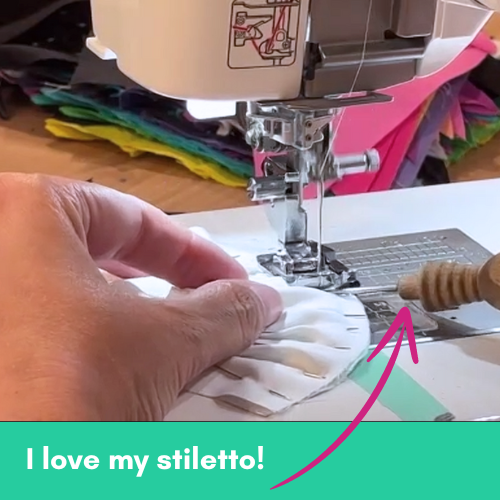
Sewing the curve with the extra help from a stiletto tool

One Stitch at a Time – Avoid the Puckers!

The key to curved piecing is joining the pieces at one spot under the needle one stitch at a time. The fabric pieces will never sit straight under the needle. Focus on this spot and let the feed dogs guide the fabric for the next stitch.

  • Set your stitch length to 1.5 to 1.8
  • Lay the pieces with the concave piece on top – you will see if it puckers while stitching.
  • Begin by sewing slowly, gently guiding the fabric so the fabric is stitched evenly along the seam line.
  • Maintain an even quarter-inch seam allowance.
  • Engage the needle down feature on your machine (if available) so your needle stays in the fabric when you stop without shifting fabric.
  • The key to sewing smooth curves lies in easing the fabric together as you sew, avoiding stretching or bunching. A few wonky stitches can throw off the curve!

TIP: Double check your stitching for puckers
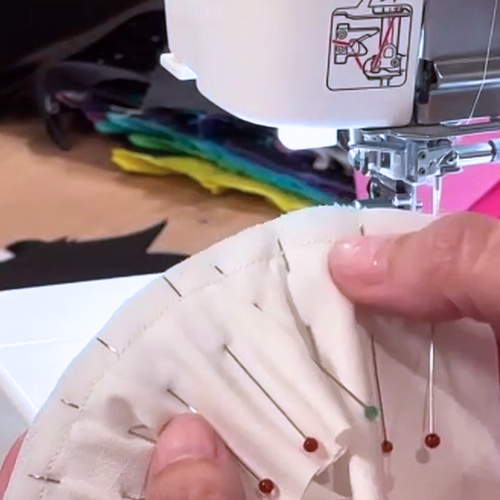
Double check for oopsies

Step 6: Pressing for a Smooth Finish

Pressing is an essential step to achieve a polished look.

  • Set the seam allowance with the tip of the iron on the wrong side.
  • Turn it over to the right side and gently finger press the allowance toward the concave piece.
Setting the seam
Finger pressing
  • Use a dry, hot iron to press the seams towards the concave side of the block. Sometimes, you’ll need to press them under the darker fabric or they may lay better in the opposite direction.
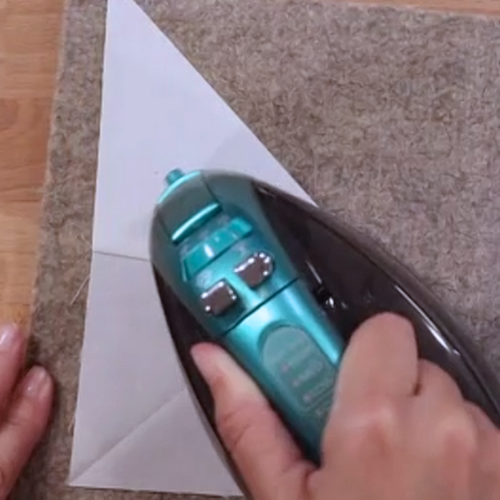
Final press on the right side of the fabric
  • Trimming an ⅛ inch off the seam allowance helps it lay better underneath the curve.

Avoid ironing in circles or back and forth (iron skating!) so the curves won’t distort and stretch. It’s better to gently lift and reposition the iron as you press. This step might seem like a small detail, but it makes a huge difference in how the block looks and behaves! Taking the time to press carefully will result in gently curved seams.

More Quilt Curves Tutorials

While the quarter-circle block is an excellent starting point, a world of curved piecing options is out there. From gentle waves to intricate swirls, experimenting with different blocks allows you to add dynamic visual interest to your quilt design.

No Pins, No Glue Method for Curved Patchwork

I’ve tried this method and for me, it works better with larger blocks (8-inches +). Smaller blocks have tighter curves and less fabric to wrangle into place. Many quilters use this method so give it a try.

Sew Kind of Wonderful offers the Wonder Curve Ruler and a YouTube video lesson making precision cuts and using your finger to align the blocks as you sew.

Glue Basting Lessons from Quilter Blogs and YouTube

Glue basting works well with curved piecing. Amy Smart, Diary of a Quilter, explains the benefits of glue in her post with Cindy Fincher’s video tutorial.

See the Lyns Avenue video with her glue method here.

You have many glue products to choose from like liquid glue and glue sticks. Use a fine tipped applicator to lay down a thin line glue. Roxanne’s Glue Baste and Elmer’s School Glue.among quilters as well as Elmer’s School Glue.

Roxanne's Glue Baste

As you can see, there’s more than one way to try out curved quilt piecing on your next quilting project. Start with the quarter circle block – you’ll find many resources for inspiration, including quilt books, online tutorials, and quilting blogs. Experiment with different methods and discover what works best for your skill level and personal preference.

Beginners Guide to Sewing Curved Quilt Blocks Graphic

frequently asked questions graphic

Frequently Asked Questions About Quilt Curves

What is the Easiest Curved Quilt Block for Beginners?

The quarter circle block, also known as the Drunkard’s Path block, is a great place for beginners venturing into curved quilt patterns. It offers a manageable curve and provides a foundation for tackling more intricate designs. Happy quilting!

How Do I Choose Fabric for Curved Quilting?

Choose fabric that shows off curved piecing like solids, tone-on-tone, small printers and blenders. Choosing fabric is depends on the quilt design and personal preferences.

Can I Sew Curved Blocks Without a Special Foot?

Yes, you can sew beautiful curved piecess using a standard sewing machine foot. The key is to maintain a slow, steady pace while sewing curves, guiding the fabric carefully to sew a smooth seam.

Join our Block of the Month programs any time, start any time, make any project, finish any time, work at your pace and repeat! Click here to learn about all of the goodies in the Club!

Aurora BOM program
more resources

  • Master Freezer Paper Piecing – 12 Easy Tips
  • Choose Easy Analogous Combinations for Quilts
  • Beginners Guide: Using a Walking Foot
  • Modern Quilt Colors: Mixing Brights Right Tutorial
  • Celebrating Quilty Progress
  • Rainbow Quilt Designs: 9 Ways to Make Inspired Rainbow Quilts
  • Hexagon Quilts Roundup
  • Aurora Block of the Month
  • Quilt Coloring Pages: 4 Methods for Successful Color

Previous Post: « Monochromatic Quilt Patterns: How-to Color Guide
Next Post: Curved Blocks are a Hit! »

Reader Interactions

Comments

  1. Mea Cadwell says

    September 5, 2024 at 4:38 pm

    Per my sewing machine doctor: Please don’t sew over pins, even if sewing slowly. Each time your sewing machine needle hits a pin it can put your timing out a miniscule amount that can add up over time. This expense is easily avoidable

    And there are videos online showing what happens if the sewing machine needle breaks a pin which can go flying right into your face or eye.

    If I can prevent just one person from having to go to the hospital by mentioning all this then I’ve done one good thing.

    • rebeccabryan says

      September 6, 2024 at 11:11 am

      Thanks for chiming in! I know this is probably my worst sewing habit. Eep!

Primary Sidebar

New 2026 Block of the Month!

Graphic of Alchemy Quilt

Join the 2026 Block of the Month Program

Get my Modern Triangles Quilt Book

Get my Modern Rainbow Quilts Book

Image shows cover of the book "Modern Rainbow Quilts"

Make the Solstice Quilt!

Solstice Block of the Month by Bryan House Quilts

Get Your Invite!

Make Modern Triangles Logo

Make the Sparkler Quilt!

Image Shows Sparkler Quilt Top by Rebecca Bryan

Make the Echo (Echo!) Quilt

Echo BOM now open to join

Make the Wildflower Quilt!

Wildflower Block of the Month by Bryan House Quilts

Make the Stargazer Quilt!

Anne's Stargazer BOM

Make the Rainbow Triangles Quilt!

Rainbow Triangle BOM, modern triangle quilt, Rebecca Bryan

About

Hey there! I’m Rebecca, an author and teacher and freezer paper piecing evangelist. I’m also the founder of the Make Modern Triangles Quilt Club.

Disclosure

Just so you know, my site includes affiliate links from which I (it’s me! Rebecca!) receive payment or compensation. Something to consider as you peruse my website. Thanks!

Latest on Instagram

I don’t know about you, but for me, quilting has n I don’t know about you, but for me, quilting has never been about just making quilts.

It’s about slow mornings, quiet time to myself, creating something with my hands, spending time doing something textile, not scrolling on the internet, spending more time creating and less time consuming...

And I think that’s exactly why so many people are being drawn to quilting today.

You want to get offline, learn something new, and have more quiet time that is just for you and your imagination. ✨

I think we could ALL use more of that in our lives, and if you want to give it a try, I’ve got a free class you can sign up for by commenting ‘FREE’ below. 💕

#modernquilting #paperpiecing #foundationpaperpiecing #quiltingtechnique #quiltteacher
I’ve taught thousands of quilters over the last de I’ve taught thousands of quilters over the last decade, and I’ve been quilting myself for over 15 years, and this is what I’ve learned. ⬇️

What’s stopping you from quilting isn’t that you don’t want to do it. It’s because you have already convinced yourself of something before even giving it a fair shot. 

You’re probably thinking something like...

👉 “I don’t think I’m creative enough.”
👉 “It looks too complicated.”
👉 “I wouldn’t know where to start.”
👉 “I don’t have enough time.”
👉 “What if I spend all that money and I’m terrible at it?”
👉 “I’ve never been good at sewing.”

If any of those thoughts have crossed your mind, can I let you in on a little secret?

Almost every quilter I know started with one of those ideas in their head, including me. 🤫

The beautiful quilts you see today didn’t begin as beautiful quilts, they began as just an idea and a willingness to try.

Nobody sits down at a sewing machine and automatically knows how to quilt.

You learn by just doing it, sewing stitch by stitch, and every time you enter your sewing room, it gets a little bit easier, and you start to enjoy it more and more. 

If something has been holding you back from quilting, I invite you to take my free class where you have nothing to lose and so much to gain. 

Comment ‘FREE’ to sign up. 💕

#modernquilting #quiltingtechnique #quiltpattern #quiltdesign #quiltersofig
Comment ‘FREEZER’ if you want to take my free clas Comment ‘FREEZER’ if you want to take my free class and learn this amazing technique! 👇

Freezer paper piecing tip number eight is to press every seam right after sewing it. 
 
Don’t wait until later or until all of your blocks are done. Press those seams right away!

It might feel like it slows you down in the moment, but it actually saves you time (and frustration) later.

When you press as you go, your seams stay crisp, and your pieces lay flat, which makes lining everything up so much easier. You’re not fighting bulky seams or trying to “fix” things at the end. 🙌

Plus, pressing helps set the stitches and keeps your fabric from shifting as you build your block.

Think of it as part of the sewing process, not an extra step.

Your blocks will be flatter, sharper, and way more accurate… and your future self will thank you!

Comment ‘FREEZER’ for my free class! 💕

#modernquilting #paperpiecing #foundationpaperpiecing #quiltingtechnique #quiltteacher
MAKE A TEST BLOCK!!! Please, I am begging you. 😅 MAKE A TEST BLOCK!!! Please, I am begging you. 😅

You’d think after 15 years of quilting I’d be able to skip it...

And every once in a while I convince myself that I don’t need a test block because I’ve made this block hundreds of times or my freezer paper piecing skills are good enough to skip it... 

And do you know what happens every time I convince myself that I don’t need a test block? 🙃

I almost always regret it and end up having a nice long date with Jack The Seam Ripper as a consequence. 

Learn from my mistakes so you don’t have to learn from your own and make the test block EVERY TIME!!!

Are you making test blocks? Tell me in the comments! ⤵️

#modernquilting #paperpiecing #foundationpaperpiecing #quiltingtechnique #quiltteacher
I can’t believe I’m saying this, but we’re nearing I can’t believe I’m saying this, but we’re nearing the final months of Dutch Summer! 🥹

Finished Dutch Summer Month 6 blocks are showing up in the Make Modern Triangles Club every day. We’re past the halfway point, and we’re really starting to stack up the blocks! Now that we’ve got a bunch of stacks of blocks, it’s such a fun time to play with arranging your blocks and see what your creativity comes up with. ✨

Once you get beyond the halfway point, you start the countdown to the BIG finish! 🎉

We’re feeling excited, motivated, and accomplished. We are covering some ground, folks! Swipe to see each month’s block so far, and drop a ‘DUTCH’ in the comments if you want to make your own! 💕

#quiltteacher #quiltingtutorial #quiltingtips #modernquilting #quiltcommunity
Comment ‘FREE’ if you’re a brand-new quilter and w Comment ‘FREE’ if you’re a brand-new quilter and want to learn an easy technique that will save you countless hours and allow you to fully enjoy the quilting process. ✨

Inside my free class, I’ll teach you the freezer paper piecing technique, a better way to foundation paper piece, and you’ll leave with a block pattern to start sewing right away! If you’ve been wanting to try out quilting, this is it! 💕

#modernquilting #paperpiecing #foundationpaperpiecing #quiltingtechnique #quiltteacher
Follow on Instagram

Browse by Category

Archives

  • Instagram
  • Facebook
  • Pinterest
  • email
I don’t know about you, but for me, quilting has n I don’t know about you, but for me, quilting has never been about just making quilts.

It’s about slow mornings, quiet time to myself, creating something with my hands, spending time doing something textile, not scrolling on the internet, spending more time creating and less time consuming...

And I think that’s exactly why so many people are being drawn to quilting today.

You want to get offline, learn something new, and have more quiet time that is just for you and your imagination. ✨

I think we could ALL use more of that in our lives, and if you want to give it a try, I’ve got a free class you can sign up for by commenting ‘FREE’ below. 💕

#modernquilting #paperpiecing #foundationpaperpiecing #quiltingtechnique #quiltteacher
I’ve taught thousands of quilters over the last de I’ve taught thousands of quilters over the last decade, and I’ve been quilting myself for over 15 years, and this is what I’ve learned. ⬇️

What’s stopping you from quilting isn’t that you don’t want to do it. It’s because you have already convinced yourself of something before even giving it a fair shot. 

You’re probably thinking something like...

👉 “I don’t think I’m creative enough.”
👉 “It looks too complicated.”
👉 “I wouldn’t know where to start.”
👉 “I don’t have enough time.”
👉 “What if I spend all that money and I’m terrible at it?”
👉 “I’ve never been good at sewing.”

If any of those thoughts have crossed your mind, can I let you in on a little secret?

Almost every quilter I know started with one of those ideas in their head, including me. 🤫

The beautiful quilts you see today didn’t begin as beautiful quilts, they began as just an idea and a willingness to try.

Nobody sits down at a sewing machine and automatically knows how to quilt.

You learn by just doing it, sewing stitch by stitch, and every time you enter your sewing room, it gets a little bit easier, and you start to enjoy it more and more. 

If something has been holding you back from quilting, I invite you to take my free class where you have nothing to lose and so much to gain. 

Comment ‘FREE’ to sign up. 💕

#modernquilting #quiltingtechnique #quiltpattern #quiltdesign #quiltersofig
Comment ‘FREEZER’ if you want to take my free clas Comment ‘FREEZER’ if you want to take my free class and learn this amazing technique! 👇

Freezer paper piecing tip number eight is to press every seam right after sewing it. 
 
Don’t wait until later or until all of your blocks are done. Press those seams right away!

It might feel like it slows you down in the moment, but it actually saves you time (and frustration) later.

When you press as you go, your seams stay crisp, and your pieces lay flat, which makes lining everything up so much easier. You’re not fighting bulky seams or trying to “fix” things at the end. 🙌

Plus, pressing helps set the stitches and keeps your fabric from shifting as you build your block.

Think of it as part of the sewing process, not an extra step.

Your blocks will be flatter, sharper, and way more accurate… and your future self will thank you!

Comment ‘FREEZER’ for my free class! 💕

#modernquilting #paperpiecing #foundationpaperpiecing #quiltingtechnique #quiltteacher
MAKE A TEST BLOCK!!! Please, I am begging you. 😅 MAKE A TEST BLOCK!!! Please, I am begging you. 😅

You’d think after 15 years of quilting I’d be able to skip it...

And every once in a while I convince myself that I don’t need a test block because I’ve made this block hundreds of times or my freezer paper piecing skills are good enough to skip it... 

And do you know what happens every time I convince myself that I don’t need a test block? 🙃

I almost always regret it and end up having a nice long date with Jack The Seam Ripper as a consequence. 

Learn from my mistakes so you don’t have to learn from your own and make the test block EVERY TIME!!!

Are you making test blocks? Tell me in the comments! ⤵️

#modernquilting #paperpiecing #foundationpaperpiecing #quiltingtechnique #quiltteacher
Follow on Instagram
© 2026 Bryan House Quilts