Key Highlights
- Use the easiest strip piecing method in this log cabin quilt tutorial perfect for beginners
- Simple, relaxing, no-rules technique
- How to select fabrics for a log cabin quilt block and creative print and color mixes
- Learn pro tips for sewing straight lines
- Step-by-step photo guide and video tutorial
Tutorial: Log Cabin Quilt for Beginners
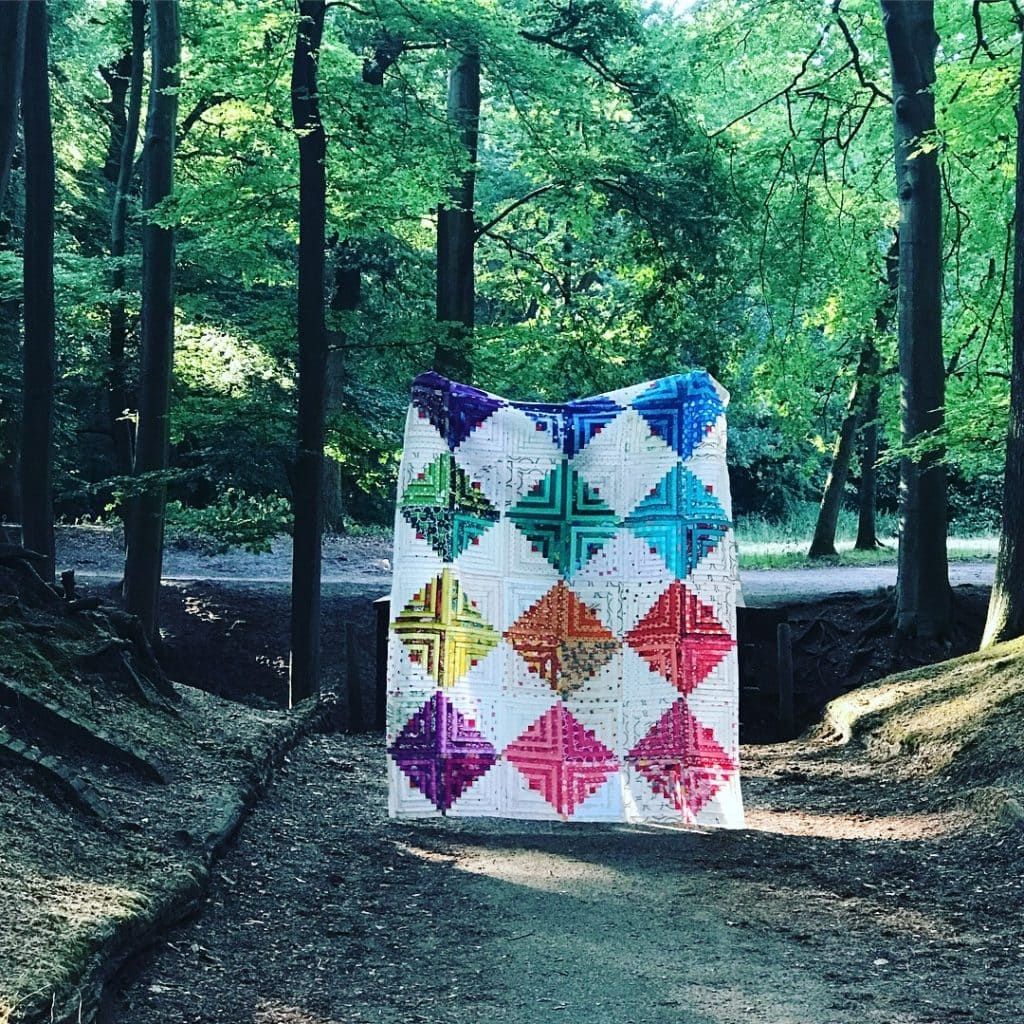
Ready to make the easiest log cabin quilt? These quilts are typically pieced with hundreds of cut-to-measure strips. But not this one! I use 1.5 inch strips cut from fat eighths or fat quarters, all the same length. If you can cut straight strips with a rotary cutter, use this tutorial for your first-time log cabin quilt block. Follow along in the step-by-step photo guide with instructions.
Sometimes, I want a carefree sew, when it doesn’t matter if the blocks end up, well, not quite square. Quilters, this is the stress-free version! Luckily, using colorful prints puts the focus on the design, and not so much on the matching. In the end, all you see is a fantastic quilt.
Classic Log Cabin Quilts for Beginners
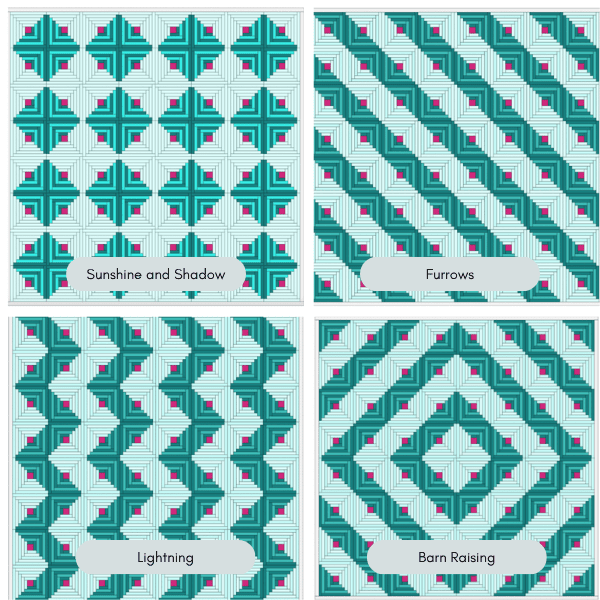
These blocks are simple in theory – different lengths of fabric strips are placed around a center square in a repeating pattern. Contrasting colors in light and dark colors make it striking. Hundreds of design options have been created by changing colors and rotating blocks to make optical illusions. The four classic log cabin quilt versions below were created with the same block, just like the one in my tutorial. Isn’t that amazing?
What Fabrics work best for a Log Cabin Quilt?
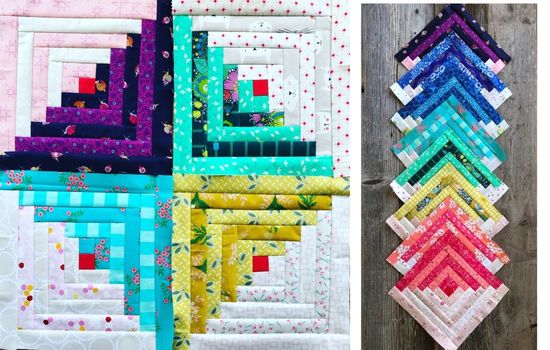
Colors with lots of contrast are beautiful in modern log cabin quilts. I can’t resist saturated colors. In this tutorial, we’ll choose color pairs for the light and dark fabrics in quilting cottons, and a bright pop of color in the center square. The contrast between the two sides of the block— light versus. dark— is the hallmark design element that makes it pop.
FABRICS REQUIREMENTS
To make this quilt, you’ll will use 48 blocks, 12 per row.
- 16 fat eighths – medium dark to dark fabrics
- 16 fat eighths – light fabrics
Each block uses approximately 1 ½ to 2 ¼ 4 strips of each color, depending on placement.
Get some extra color help in this post about choosing monochromatic pairs and color schemes.
- Start by pairing up your dark fabrics into sets of 2 fabrics.
- Then pair up your light fabric choices.
- Pair up a light and dark set and repeat for all of the fabric pairs.
PRO TIPS:
- Use fat quarters or fat eighths from a designer’s collection – they all go together.
- Large, multi-color prints blur the edges between fabrics, especially when the background color is similar to your light fabric pairs. Lay out your strips side by side to make sure you have enough contrast. Want the blurred effect? Use the big prints.
- Use solids or blenders for a modern look and definitely a pop of the color contrast in the center blocks.
Sewing Notions
- Sewing machine
- Rotary cutter with sharp blade and self-healing mat
- Quilting ruler
- Iron and ironing board
- Straight pins or clips
- Square up ruler
- 50 weight thread and 80/12 machine needle
Step-by-Step Guide for Log Cabin Quilt Block
This easy step-by-step guide shows you how to make a log cabin block from start to finish. When you finish one, you’ll want to make more.
1. Cutting Fabrics
First, wash (or not wash, your choice) and then press your fabrics with Best Press. This stabilizes the fabric for cutting into strips. Use a rotary cutter and a quilting ruler on a self-healing mat.
Square up the edges of your fabrics before cutting strips. Each strip is 1.5 inches wide cut on the crosswise grain of a fat quarter and 20 inches long. You can get 11 strips from one fat quarter and 5 strips from a fat eighth.
2. Sewing Straight Lines
Use a 1/4 inch seam allowance. When you’re a beginner, stop and check the seams often with a small ruler or sewing gauge. Get extra help for sewing strips together better here.
Sewing straight lines will keep your quilt blocks square and the seam allowances even. When you sew the blocks together into rows, the seams are more likely to line up.
Try out these easy tips:
- Use a seam guide to line up the edges of the fabric under the needle.
- 1/4” piecing foot is super helpful and worth having on hand.
- Go slowly when you sew. You can pick up the pace eventually.
- Keep the strips flat while you sew.
- Gently feed them under the presser foot – no pushing or pulling – so the feed dogs do the work.
3. Assembly
This method is quick because you will work with one long strip at a time and trim as you go.
Be sure to always place the right sides together. Press your seams toward the outer edge of the block. Give the right side of the block a quick press before you move on.
One good tip for new quilters is to lay out your strips in the order you will sew them. It keeps the process smooth and also prevents you from color mix ups.
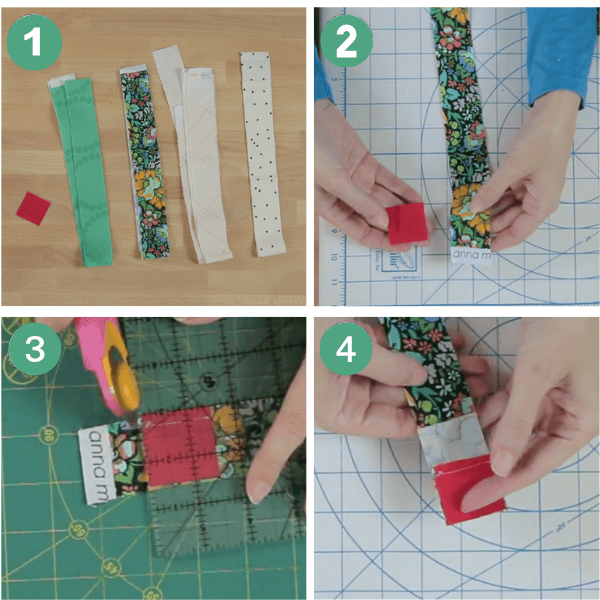
Steps 1 through 4: Starting at the center block
1. After cutting, group your fabrics into block sets: 2 strips light fabrics and 2 strips dark fabrics and one center square.
2. Lay a dark strip right side up and place the center square at the end, matching edges. Sew along the top edge
3. Trim off the excess dark fabric at the end of the strip, even with the center square. Finger press the seam open.
4. Place the sewn pieces on top of the dark strip again, right sides together. Sew along the top edge.
NEXT ROUND
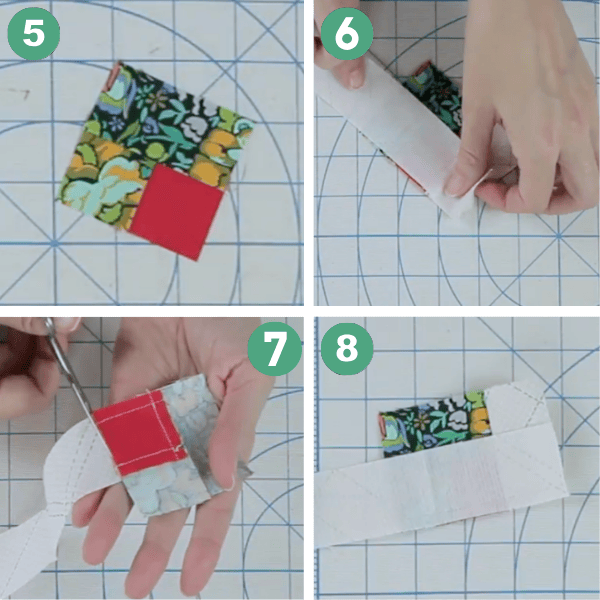
Steps 5 through 8: Adding the light fabric
5. Trim excess dark fabric and you have your first square. Press with a hot iron.
6. Join a light fabric strip, matching one of edges along the center block. Stitch along that edge.
7. Trim excess the light fabric. Use a scissors or a rotary cutter.
8. Place the long strip matching the edges along the center block. Stitch along that edge.
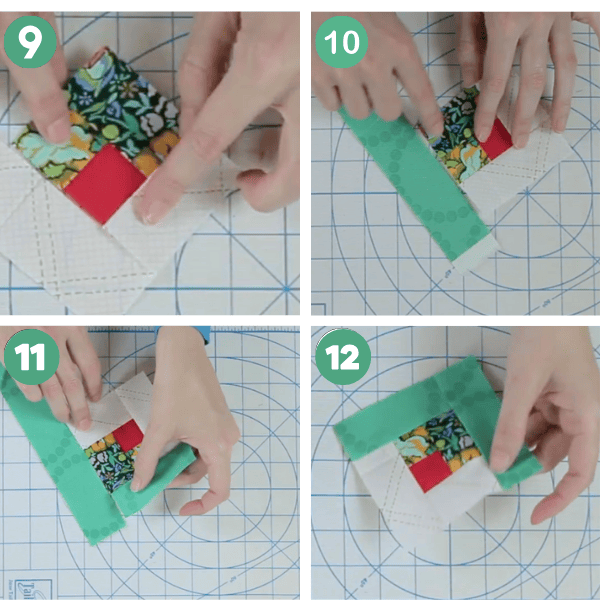
Steps 9 through 12: Adding the second set of dark fabric strips.
9. Press open.
10. Add the other dark fabric strip opposite of the first set of dark strips.
11. Add another dark strip as you work around the block adding strips.
12. Press open.
Now you have completed a full rotation around the center square. Repeat steps 8 through 12 by adding two consecutive light and dark strips to complete the block.
Step 4: Square up Blocks and Finishing
Squaring up each block is the last step before piecing the rows together. You will need a square-up ruler or you can use the grid on your cutting mat and match up the side and bottom edges to get a straight cut.
Measure each log cabin quilt block two times before you cut. Trim your block so it matches the finished log cabin quilt block size 10.5 x 10.5 inches. Put the ruler in place, check if all the sides are even and straight, then trim off any uneven edges. Doing this makes sure your quilt blocks fit together well in the finished quilt.
Before you start putting the quilt top together, take a minute to look over your log cabin blocks. Make sure they are the same size and shape. Press them one last time. After that, you can sort the blocks by color or set them up how you want the layout to look. Paying extra attention now helps to avoid problems later.
To make your quilt top, lay out the log cabin blocks on a flat surface in any log cabin design. Working left to right, stitch the top row together by joining the sides of the blocks. Press the seams flat after each block is stitched as well as on the right side of the top.
Match the vertical seams in each row and pin or clip them to hold in place. Join two rows at a time, then join the pairs of rows. And you are done with the quilt top!
Conclusion
I hope you try this easy method for stitching up a log cabin quilt for beginners. Or just make one block. This log cabin quilt design and method is meant to be relaxing and fun with a no-rules approach. I love this process and the results, and I think you will too.
Frequently Asked Questions
How do I assemble log cabin blocks into a full quilt top?
To make your quilt top, lay out the log cabin blocks on a flat surface in any log cabin design. Working left to right, stitch the top row together by joining the sides of the blocks. Press the seams flat after each block is stitched as well as the right side of the top.
Match the vertical seams in each row and pin or clip them to hold in place. Join two rows at a time, then join the pairs of rows. And you are done with the quilt top!
What is the ‘quilt-as-you-go’ method and how does it work for beginners?
The quilt-as-you-go way lets you sew and quilt each block on its own. You can then join the blocks together later. This is good for people who are new to quilting. You get to work with smaller pieces at a time on your sewing machine, so the quilt is easier to manage and not as heavy.
Are there easy machine quilting designs for finishing my log cabin quilt?
Yes, straight lines, soft diagonal lines, or a simple grid are all great ways for beginners to try quilting on a log cabin quilt. Learn more about using a walking foot for quilting which makes straight line quilting so much easier. Leah Day has a gallery of designs and excellent videos on her blog.
Free Patterns and Tutorials: Log Cabin Quilt Blocks
These free patterns and tutorials are a great place to find inspiration for a log cabin quilt block:
- Use the traditional method to make it with strips cut to size on the Freshly Pieced blog.
- Watch a video tutorial using the traditional method by Riley Blake Designs blog.

This has never been my favorite block to make but after watching you I plan to give it another try. Thanks in advance!!!
It’s so versatile! If you find you like making log cabins, why not explore different designs using the block? You might find a design that makes your heart go pitter pat!
But if you don’t enjoy making it… ha! It’s fine to leave it in your quilty past.
Enjoy!